The Outcomes Assessment
Your museum has an alignment problem disguised as a measurement problem.
Your team talks about engagement, impact, and community connection. But ask three people which outcomes your museum delivers, and you’ll get three different answers.
Which of these 24 outcomes is your museum delivering?
You probably recognize most of these. You might even have a gut sense of which ones your institution delivers well. The harder question — does the rest of your team see it the same way?
- Participants feel physically safe, welcome, and secure
- Participants are immersed in an exciting or beautiful setting
- Participants feel relaxed or calm
- Participants experience moments of joy and happiness
- Participants’ senses are heightened and/or stimulated
- Participants feel free from work and routine
- Participants do and see things they like or enjoy
- Participants satisfy their curiosity and/or learn about topic(s) they find interesting, important, and/or timely
- Participants think about important issues and see things in new perspectives
- Participants feel intellectually safe and secure
- Participants’ understanding of something is confirmed or affirmed
- Participants discover new things about themselves
- Participants find something to talk about with friends or family
- Participants feel socially, culturally, and/or emotionally safe and secure
- Participants support the learning, joy, or relationship of/with their child, partner, or companion
- Participants gain awareness and understanding of their own or another culture/society
- Participants feel connected to something bigger than themselves
- Participants spend quality time with others beyond their own group or family
- Participants experience moments of creative inspiration and/or imagination
- Participants feel awe and amazement
- Participants see or do things they do not usually get to see or do
- Participants experience something special, inspiring, or valuable
- Participants feel a sense of connection/belonging with members of their group or community
- Participants act in new ways/do new things
Try this
Pull up the list above with your director and ask: “Which of these do you think our staff would say we deliver?” It’s a five-minute conversation that tends to open the door to larger ones.
The 24 outcomes are drawn from our partner John Falk’s research on the experiences people seek and find in cultural organizations.
The Assessment
The Outcomes Assessment surveys your staff on which of these 24 outcomes they believe your museum delivers, how, and where they diverge. The result is an alignment profile — showing where your team agrees about what you’re delivering to visitors, and where convergence still has to happen.
Every institution that participates receives:
- Full assessment deployment to your staff
- Your institution’s outcomes alignment profile
The Outcomes Assessment is free. It takes about 15 minutes per person to complete.
What your alignment profile reveals
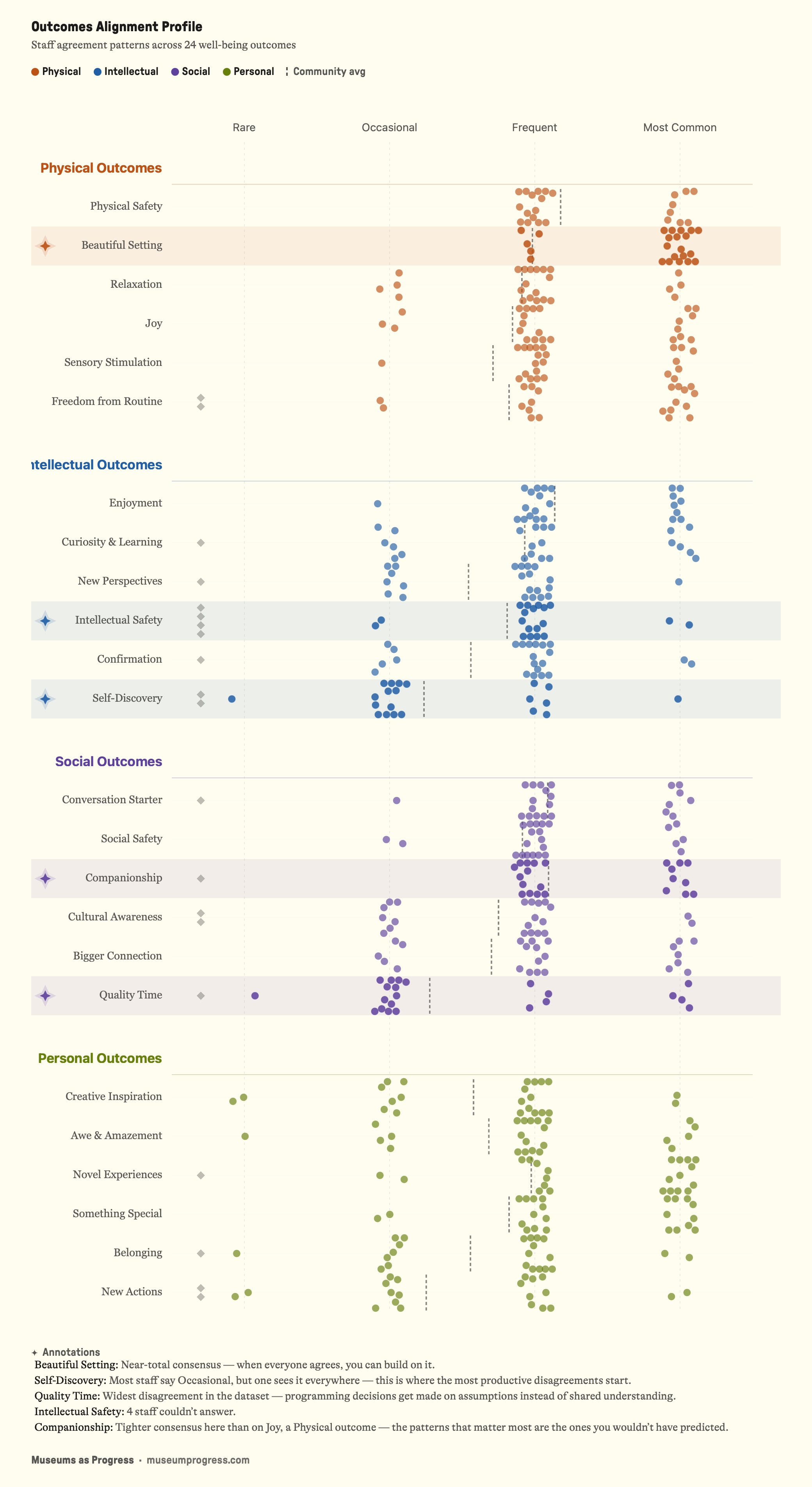
Each dot is one staff member’s perception of how often your museum delivers an outcome. Where dots cluster, your team agrees. Where they scatter, you have a conversation worth having.
The gaps aren’t problems — they’re the starting points for decisions your team hasn’t been able to make because nobody had the same picture.
The assessment produces data you can use to begin prioritizing which outcomes should inform your strategic plan.
Why staff perceptions and not visitor surveys?
Because visitor outcome data is only as useful as your team’s agreement on what you’re trying to deliver. If departments disagree on which outcomes matter, visitor data becomes ammunition for whoever’s loudest. The alignment map gives your team a shared starting point first.
Surveying visitors across all 24 outcomes directly would ask them to reflect on dimensions your institution hasn’t yet decided to prioritize — deferring a strategic choice, and spending visitor goodwill in the process.
What changed at one museum

“The museum hadn’t been listening to its people — there hadn’t been consistent efforts at this kind of work. So to go from essentially nothing to ‘we want our decisions based on data we can gather about our visitors’ — and not just demographic data — that shift has been significant.
I think it’s amazing to hear people who rarely talked about our visitors at all now say ‘maybe that could be a listening session’ when a question comes up. People are starting to think there’s another way we could figure that out.
It’s become part of our language now. I’ll be in a meeting and say ‘can I throw a MaP thing out there?’ and everyone knows instinctively — she’s talking about visitors, she’s going to talk about outcomes. It’s just the jargon now.”
Amanda Boehm-Garcia, Head of Museum Experiences, Fred Jones Jr. Museum of Art
What happens after the assessment?
The assessment gives you a picture of where your institution stands. What comes next depends on your role and what your institution needs.
For department heads and senior managers
Outcomes Lab is a working group for professionals putting outcomes-based practice to work. Members bring real challenges — making the case for outcomes work when leadership isn’t bought in, choosing which outcomes to prioritize when resources force a trade-off, and translating alignment data into language that holds up in a planning conversation.
The value comes from practitioners comparing notes in real time, alongside people navigating the same dynamics.
Outcomes Lab is free. Your institution needs to have completed the assessment to participate.
For directors
Some institutions want help connecting outcomes data to institutional decisions — understanding what alignment gaps mean for strategic planning, how outcomes evidence strengthens a case for funding, or where to focus when the data raises more questions than it answers.
These are paid engagements that bring applied expertise to your data — not a different version of the assessment, but a different kind of work with it.
Get Started
Institutions often begin this work when entering a strategic planning cycle, navigating a leadership transition, or approaching a grant reporting deadline — moments when the gap between what your team believes and what you can articulate becomes urgent.
We send you a unique survey link and a ready-to-send email for your staff. The survey takes about 15 minutes per person, and we calibrate the participation target to your institution’s size. Your part is letting your team know it matters. We handle the rest.
Once your team has participated, you receive your outcomes alignment profile within one week.
Request the Assessment →